
When you hire a home inspector, you are hiring a set of eyes. However, the value of those eyes depends entirely on the specialized training and the “technical lens” behind them.
In the National Capital Region (NCR), home inspectors come from a variety of valuable backgrounds. At TrueBuild Inspect Inc., we add an extra layer of analytical depth to this field. Founded by a professional with a Degree in Civil Engineering, we approach every property with what we call the “Engineering Edge”—a focus on the science of how a home functions as a complete system.
Before we dive in, it is important to clarify the scope of a professional home inspection. According to the InterNACHI Standards of Practice, a home inspection is a non-invasive, visual examination.
As your home inspector, our role is not to perform structural engineering calculations or pull municipal permits. Instead, we use our Civil Engineering education to better interpret the visual evidence we find. We don’t just see a “visual defect”; we understand the physics and the “why” behind it, allowing us to provide you with a more informed perspective.
A standard inspection might identify a crack in a foundation wall. An inspector with an engineering background looks at that same crack and evaluates it through the lens of structural mechanics: Is this simple concrete shrinkage, or is it a sign of differential settlement?
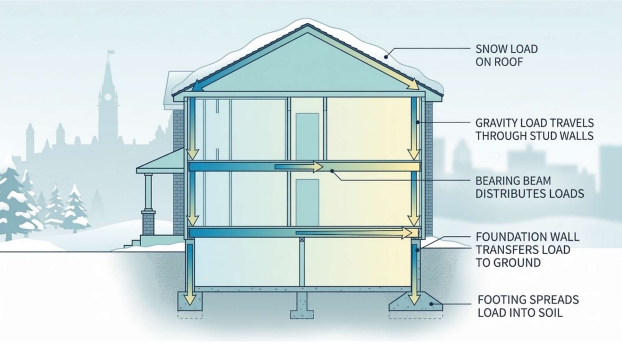
While we stay strictly within the limits of a visual audit, our academic training in load paths (how weight travels from the roof to the ground) helps us identify “red flags” that might otherwise be missed. In Ottawa, where heavy snow loads and expansive clay soils are common, understanding these stresses is vital for a comprehensive visual assessment.
In neighborhoods like Kanata, Stittsville, or Orléans, soil composition plays a massive role in a home’s long-term health.
The Visual Clue: A backyard slope leaning toward the foundation.
The Engineering Perspective: We evaluate this through the principle of hydrostatic pressure. We aren’t just looking at a damp basement wall; we are identifying a site grading issue that may be exerting significant water pressure against your foundation.
By identifying these drainage patterns early, we help homeowners understand how the environment around the house affects the structure itself.
Rather than viewing a house as a disconnected list of parts, our engineering training teaches us to view it as an integrated system.
We analyze how the HVAC system interacts with the building envelope and how attic ventilation levels can impact the lifespan of your roofing materials. Our goal is to provide a report that doesn’t just list deficiencies but explains the relationship between different components of the home.
Our background in Construction Project Management and municipal infrastructure means our documentation is rigorous. We provide data-driven reports that use precise technical terminology, making them highly useful for realtors, lenders, and savvy buyers.
To enhance our visual inspection, we utilize advanced technology:
Infrared Thermography: To identify thermal bridges and hidden moisture.
Sewer Scopes: To verify the critical line to the municipal city connection.
A home inspection is more than a checklist; it is an exercise in technical scrutiny. At TrueBuild Inspect Inc., we stay strictly within the professional bounds of a safe, non-invasive visual inspection, but we apply an engineering-trained mind to every discovery. We look past the cosmetic finishes to help you understand the “bones” of the building.
Ready to get the “Engineering Edge” on your next property?